
From Repetition to Recognition in Lettering Practice
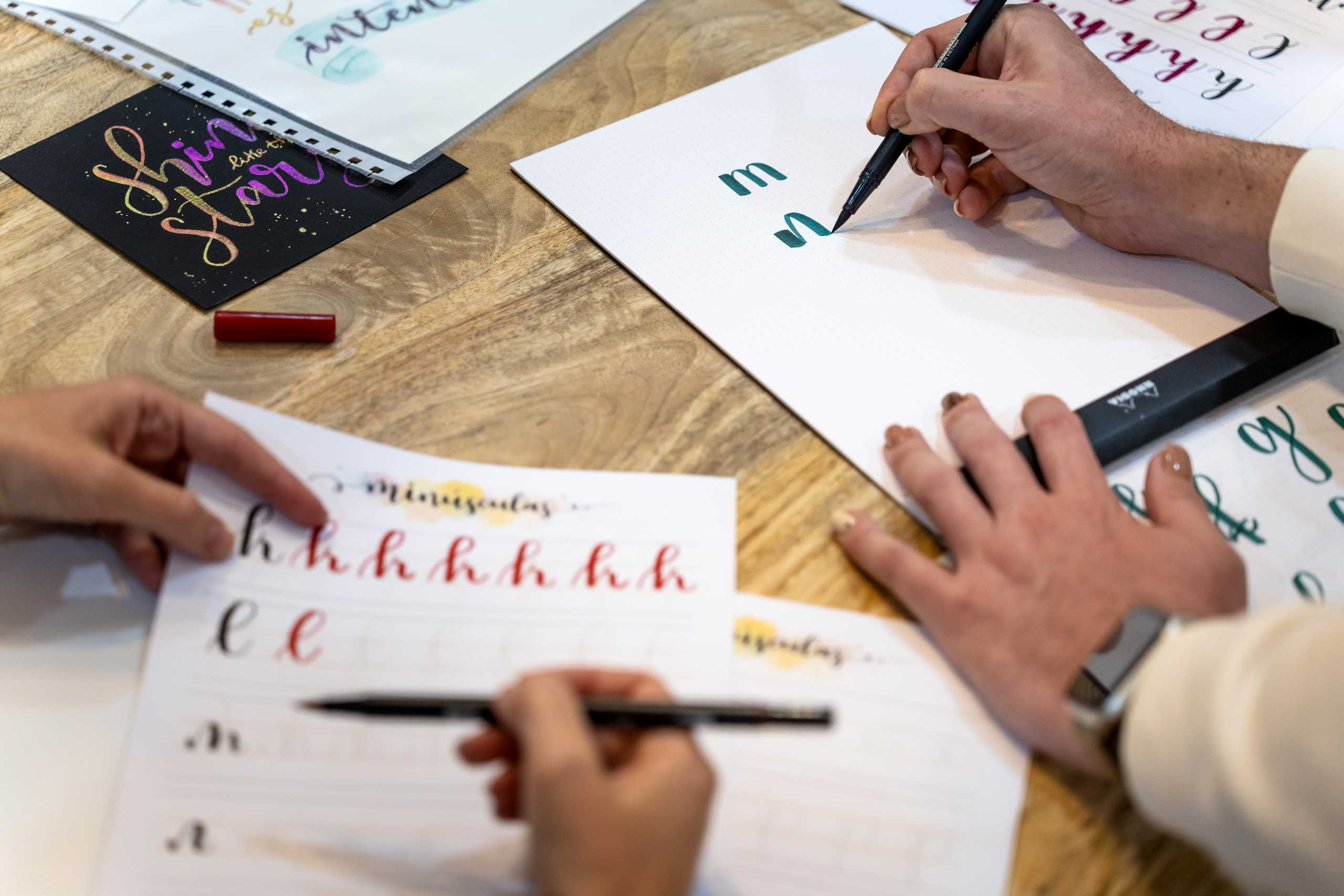
When you are starting out with lettering, the act of repeating letters and strokes can sometimes feel a bit mindless. You are essentially copying the same shapes over and over again, and there isn’t much to differentiate between them. This can sometimes be misconstrued as an un-creative act, but it is a necessary one. The goal of repetition is not to be creative, it is to establish a baseline. Before you can create with your hands, you must first be able to make them perform a task reliably. Without establishing a baseline of repetition, you will not be able to make intentional changes.
The difference between mindless repetition and repetition that fosters growth is simple: attention. If you are repeating letters without paying attention to how you are making them, you are wasting your time. If you pay attention to what you are doing while you repeat, however, you will begin to notice things. No two letters or strokes that you make by hand are identical. Even if they look the same to the naked eye, there will be some small differences in the amount of pressure you applied, the angle of your hand, and the speed at which you drew the line. If you are paying attention as you repeat, you will start to notice these subtle differences. You will begin to ask yourself questions about why certain things happened. Instead of asking yourself how to make a letter, you will start asking yourself why a letter turned out a certain way. This is how you will know you are in a pattern of repetition that fosters growth.
As you repeat, you will also begin to recognize patterns and develop your powers of observation. You will notice that you always seem to make the same mistake when you approach a letter from a certain angle. You will notice that one flourish always seems to resolve more clearly than another when they are placed in certain contexts. Over time, you will even begin to anticipate how a letter or a stroke will turn out before you have even finished it. This is a key insight, because it means that your body is learning to make predictions before something is finished, rather than simply reacting to the results after the fact. Your ability to recognize patterns and make predictions will eventually overtake your need to correct mistakes.
This is also where your personal “style” will start to develop. So-called “style” is one of those nebulous terms that I think is often misunderstood. Most people would say that someone’s style is an inherent part of who they are, and use it to describe someone’s aesthetic or the way they present themselves. In lettering, however, style simply refers to someone’s consistent mode of decision-making. As you recognize patterns and develop your powers of observation, you will begin to make more informed decisions about the work you create. You will realize that every flourish does not need to be there, and that every variation is not necessary. You will develop a sense of personal style, and it will be characterized by restraint, not embellishment. Your personal style is simply a reflection of what you understand well enough to simplify without losing the essence of the original.
The process of moving from simple repetition to informed recognition requires patience, because the results are not always dramatic. You won’t feel like you’ve turned a corner or reached a milestone, you will simply feel like you’ve gotten a bit of a groove on. But this is one of those times where the journey really is the reward. Once you start working out of a place of recognition, practice will no longer feel like work. It will feel like a conversation. The page will talk back to you, and you will be able to talk back to it. Your letters will begin to convey what is in your heart, rather than just conveying how hard you worked at them. This is the true purpose of repetition: it doesn’t just train your hand, it trains your judgment. And once your judgment is trained, it will always guide your hand as you work.